
Romance · Published by EpicHear
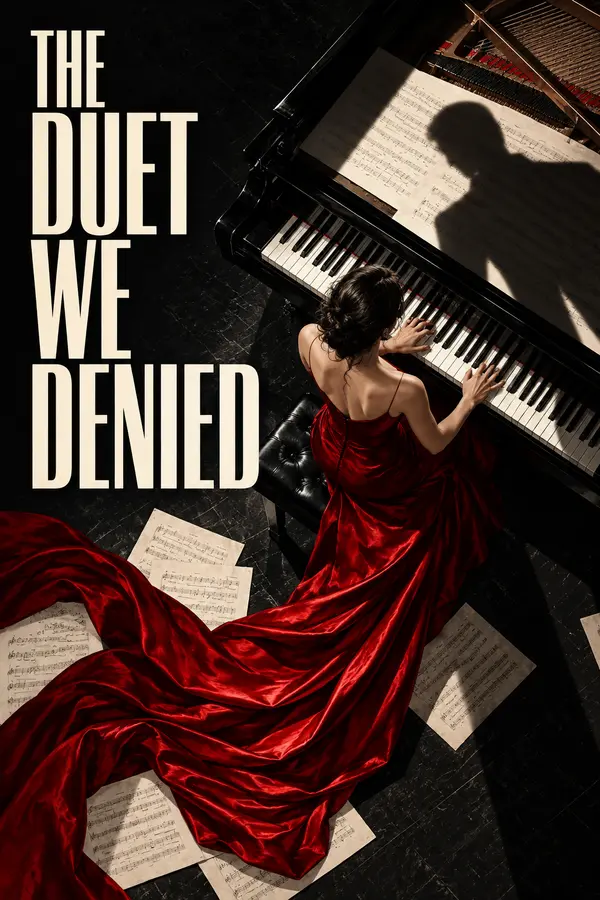
The Duet We Denied
The Letter Never Delivered
First 5 episodes free · 4 more: 4 coins, or free with the 24-hour wait (1 episode a day).
1 coin = 1 episode
About this book
Singer Mara Voss never expected to perform with the man she once loved and failed. When Noah returns to write one last duet, desire reignites alongside a bitter dispute over their early songs. Choosing each other again will mean risking the careers—and the comforting lies—they built apart.
ABOUT CHAPTER 3
The Letter Never Delivered
An intimate rehearsal brings them closer until Mara exposes the choice she has kept hidden.
Ep 3 · The Letter Never Delivered
Share a short audio preview
Create up to 20 seconds from 0:00. Available for free opening episodes. Preparing a clip downloads this episode on your device.
Read episode 3
“What did it say?” Mara asked.
Noah remained beside the piano, his bag open in his hands.
“That I was going to the coast for a week. That I needed you to decide whether there was a place for me in the record, or only in your flat.”
She closed her eyes. For seven years she had imagined a more romantic letter, if she imagined one at all. An explanation. A promise. What she had missed was a question she should already have answered.
“I thought you left because my father offered you money.”
Noah's expression hardened. “He told you that?”
“He said you wanted out.”
“I wanted my name on the songs.”
Mara called Stefan before her courage thinned. She put the phone on the piano and asked about the envelope.
Her father sighed. “This again.”
“It hasn't been again for me.”
“There was a letter. You were exhausted. The label was waiting. I didn't think a musician's ultimatum would help.”
Noah turned toward the empty auditorium.
“You kept it from me?” Mara asked.
“I kept you working. You'd spent years trying to get there.”
“Where is it?”
“I don't keep every piece of paper.”
She ended the call. For a while neither of them spoke.
Then Noah said, “He didn't keep your phone from you.”
“No.”
“Or mine from me.”
She looked at him.
“I could have called,” he said. “I decided silence was an answer because it was easier than hearing you say it.”
Mara sat on the edge of the stage. “I was a coward.”
“So was I. Unfortunately that doesn't make us even.”
The admission did not bring them closer immediately. It opened a space in which they could stop fighting an imaginary version of the other. Noah sat beside her, leaving room for an instrument case between them.
She told him about the first tour: the hotels, the relentless interviews, the way she had learned to say she wrote best alone. He told her about small shows with faulty microphones and a teaching job he had pretended not to need.
“Did you listen to my records?” she asked.
“The first one, once.”
“And the others?”
He looked at his hands. “All the others.”
Mara let that answer settle somewhere she had been keeping empty.
At the end of that conversation, Noah took out his phone and showed her a photograph of his old room on the coast. A narrow window, an electric kettle, a keyboard balanced on a table that was too small.
“I kept telling myself I'd come back when I had something to offer,” he said.
“You already had something.”
“I wanted something your father couldn't dismiss.”
Mara looked at the picture. “I should have been the person he couldn't dismiss.”
“Yes.”
She handed the phone back. The simple agreement hurt, but she preferred it to another excuse made on her behalf.
“What were you writing there?”
“Mostly bad songs about someone who looked remarkably like you.”
“Did you keep any?”
“One. I changed the ending.”
“Better?”
“Less self-pity. More weather.”
She smiled. He played a few bars on the piano, and she recognised neither the melody nor the man in it. That was unexpectedly reassuring. There was still something new to learn about him, something not trapped in the account of who had hurt whom first.
That evening, Ines brought in Ava Chen to arrange percussion for the new song. Ava was Noah's age, brisk and funny, with silver rings that clicked against her sticks. She greeted him with a kiss on the cheek and took the stool beside his without asking where she should sit.
Mara disliked her for almost a minute.
Then Ava asked whether the bridge was meant to sound like somebody leaving or somebody trying not to. Mara said trying not to. Ava removed half the drum pattern, and the song suddenly had a pulse instead of a march.
“I hate that you're right,” Mara told her.
“Excellent. That usually means I'm useful.”
They worked until the theatre staff wanted to lock up. Ava invited them for noodles, but Mara said she needed sleep. Noah watched her put on her coat.
“Then I'll walk you upstairs.”
“It's one flight.”
“I've been practising.”
Ava grinned at him with an intimacy Mara could not classify and left.
Before they reached the stairs, Ava came back for a forgotten scarf. She caught Mara alone at the coat hooks.
“You don't have to like me,” she said, cheerfully enough to make denial impossible. “But don't turn him into the man who waited seven years for you. He had a life. Quite a good one, in places.”
Mara lowered the coat she was holding. “Is that what you think I'm doing?”
“I think it's tempting. For both of you. It makes all the wasted time sound noble.”
Ava found her scarf beneath a pile of music stands. “For what it's worth, he laughs more when you're in the room. He also checks his phone more. I prefer the first thing.”
She left before Mara could decide whether to thank her. Noah emerged from the auditorium carrying two bags and offered Mara the lighter one. She took the heavier. He opened his mouth, reconsidered, and let her carry it.
That small restraint stayed with her. Once, she would have assumed he could handle everything heavy. Once, he would have made sure she never found out whether he could.
On the stairs Mara asked, “Were you together?”
“Ava and me? For a while. Four years ago.”
“And now?”
“We're friends who know which arguments aren't worth having.”
“Sounds mature.”
“Mostly it saves time.”
He stopped outside her door. She wanted him to be jealous of Simon in some precise equal measure, wanted proof that she was not the only one foolish enough to feel possessive over years she had not lived with him.
“Do you think about him?” Noah asked.
“Simon?”
“The man you almost married. Yes.”
“Of course.”
He nodded and looked down the stairs.
Mara touched his sleeve. “Being relieved doesn't mean I don't care that I hurt him.”
“I know.”
“Do you?”
He met her gaze. “I'm trying to.”
There was no music now to tell them when to enter. He stood close enough that she could see the faint mark his spectacles left beside his nose. She wanted to kiss that ordinary mark. It frightened her more than wanting the rest of him.
“I shouldn't ask you in,” she said.
“Then don't.”
“But I want to.”
His hand settled against the banister. “Mara, I can't be the room you hide in while you decide what your real life is.”
“You wouldn't be.”
“You don't know that yet.”
She took the rebuke without withdrawing her hand. “Then just stay here a minute.”
He did. They stood in the narrow landing until the silence changed.
When she kissed him, he was still for one startled heartbeat. Then he set his bag down and drew her closer. The years did not vanish. They were there in the way he waited for her to move again, in the careful pressure of his hand at her waist, in the sound she made when she realised she remembered him and did not know him at all.
She stepped back first, breathing unevenly.
“That's not a decision,” she said.
“No.” His forehead rested briefly against hers. “But it is a complication.”
She laughed, and he kissed the corner of her mouth before picking up his bag.
Inside, Mara sat on the bed without taking off her coat. Her phone held a message from Stefan: she should understand the whole situation before making accusations. Attached was a scanned page from the original album agreement.
She recognised her signature immediately.
Below the list of songs, including two she and Noah had written together, was a statement approving sole writing credit in her name.
She had signed it. She had always known she had signed it.
What she had not done, in all those years, was look directly at that fact without placing her father's voice in front of it.
She opened a message to Noah. Typed, deleted, typed again.
There was something I didn't tell you today.
She sent the page before she could improve the wording into another excuse.
His reply arrived while she was still holding the phone.
I asked you, that week. You said the credits weren't final.
Mara stared at the screen. Then the next message appeared.
Were they already final when you said it?