
Romance · Published by EpicHear
The Duet We Denied
The Ring in Its Box
First 5 episodes free · 4 more: 4 coins, or free with the 24-hour wait (1 episode a day).
1 coin = 1 episode
About this book
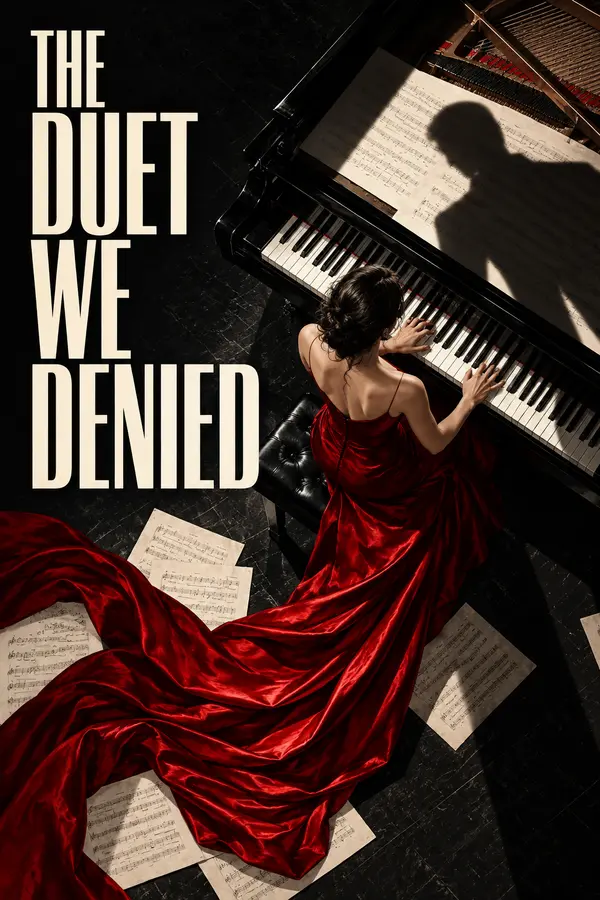
Singer Mara Voss never expected to perform with the man she once loved and failed. When Noah returns to write one last duet, desire reignites alongside a bitter dispute over their early songs. Choosing each other again will mean risking the careers—and the comforting lies—they built apart.
ABOUT CHAPTER 2
The Ring in Its Box
Mara ends her engagement and starts a new song with Noah, but an undelivered letter changes their history.
Ep 2 · The Ring in Its Box
Share a short audio preview
Create up to 20 seconds from 0:00. Available for free opening episodes. Preparing a clip downloads this episode on your device.
Read episode 2
Mara drew the agreement toward her and crossed out the rest of the promotional line.
“Then we write something true.”
Noah watched her uncapped pen. “For the poster, or for us?”
“I don't know that there is an us.”
“There isn't. That's why the distinction matters.”
She wrote: two voices, one new song. It was modest enough to survive scrutiny. Noah read it, nodded, and put his name beside hers.
For the first hour they worked badly.
Mara brought a chorus polished to a shine. Noah played it once and asked what happened between the first line and the last.
“It's a chorus.”
“It still needs to go somewhere.”
She asked whether his new album had come with a certificate authorising him to be insufferable. He said the certificate had arrived separately. She laughed despite herself, and for three dangerous seconds they were in the kitchen again.
Then her phone lit up with Simon's name.
She silenced it. Noah closed the piano.
“We can take a break.”
“We've barely started.”
“Yes.”
He did not look at her hand, which was worse than looking. Mara gathered her pages too quickly. One slid under the piano. They both reached for it; their fingers met on the dusty floor.
Noah moved back first.
At home, Simon was packing for a two-night business trip. Three ties lay on the bed, each a different shade of sensible.
“I called because your father asked me to speak to you.”
“About Noah.”
“About the concert. About the wedding. Apparently they're now the same conversation.”
“They shouldn't be.”
Simon folded a shirt. “Then tell me where I stand.”
She sat on the edge of the bed. This room had never contained an argument loud enough to be heard outside it. Mara had once mistaken that for peace.
“You deserve someone who is certain.”
He stopped folding. “Don't do that. Don't tell me what I deserve so you don't have to tell me what you want.”
The rebuke was fair. She let it land.
“I don't want to marry you.”
His face emptied so completely that she wished, for one shameful second, that she could put the lie back.
“Yesterday you didn't know.”
“Yesterday I didn't say it.”
“Because of him?”
“Because I liked being chosen by you more than I wanted the life we were choosing.”
He sat in the chair opposite. She had never seen him look older than his clothes before.
“I thought we were happy.”
“We were comfortable. I let you believe that was enough.”
Simon looked toward the window. Outside, a delivery van struggled to reverse between parked cars. Its repeated warning sounded absurdly cheerful.
“I can change things,” he said. “The house, the date. I don't need a particular wedding.”
“I know. This isn't something you can arrange differently.”
She took off the ring and put it on the bedside table. He asked her not to leave it there, as though its position made the decision theatrical. She placed it in its box instead.
They discussed practical matters because there were practical matters. The flat belonged to him; she would collect her remaining things after the trip. She would call their guests herself. They would split costs already committed. Neither would issue a statement that suggested the other had behaved cruelly.
At the door he said, “I hope you know the difference between being alive and being in trouble.”
She had no clever answer. She took her suitcase down the stairs.
Ines found her a short stay in the flat above the theatre's costume workshop. The heating knocked all night. There were three mismatched mugs, a narrow bed, and a kettle that needed its lid held down. Mara slept better than she expected and woke feeling guilty about that too.
Noah noticed her bare hand at rehearsal. He said nothing until they were alone.
“You don't have to tell me.”
“I ended it.”
He placed his pencil carefully on the music stand.
“I'm sorry.”
“Are you?”
“For the part that hurts you. Yes.”
She leaned against the piano. “Don't look pleased. I can't bear that today.”
“I'm trying not to look anything.”
“You've never been good at that.”
He met her eyes. “Neither have you. Only better rehearsed.”
She should have disliked the remark. Instead she felt the relief of being recognised without being rescued.
They threw away her chorus.
Noah began with a rhythm tapped against the piano's wooden side. Mara found a phrase over it, quiet and unsteady. He repeated the rhythm until she trusted it. Their new song began with someone standing outside a door, wondering whether knocking would be kindness or selfishness.
“Too obvious,” she said.
“Only to us.”
Ines came in while they were arguing about a single word. She listened from the door, then asked whether they wanted the publicity photographer to take rehearsal pictures that afternoon.
Mara's automatic answer was yes. Noah's was no. They looked at each other, startled by how quickly an ordinary question could become an old argument.
“Not yet,” Mara corrected herself. “We haven't decided what we're showing.”
Ines offered Friday instead and left.
Noah rubbed a hand over his face. “I don't want to become a dramatic chapter in your comeback story.”
“Neither do I.”
“You'd be the one coming back.”
Mara considered that. “Then we approve the photographs together. And the caption. Or we don't use them.”
He looked sceptical, but the arrangement was concrete enough to test. She sent Ines a message confirming it and showed him before sending. Noah changed one phrase, removing the suggestion that he was a guest on a song they were both writing. Mara accepted the correction without making him explain why it mattered twice.
At noon a young man arrived carrying sandwiches. Noah rose so fast that the piano stool scraped behind him.
“Eli.”
Mara remembered a seventeen-year-old with untidy hair and a skateboard he had insisted on keeping indoors. This man was twenty-four, walked with a slight unevenness, and looked at her as though she had spoiled the room by entering it.
“I didn't know she was here,” Eli said.
“It's her concert.”
“I thought you were arranging something.”
“We're writing.”
Eli set the sandwiches on a chair. “Right.”
Mara stood. “It's good to see you.”
He acknowledged the sentence with a small movement of his head. Nothing more.
Noah followed him into the corridor. Mara could not hear their words, only the tones: Eli low and clipped, Noah deliberately quiet. She hated herself for listening and remained where she was.
When Noah returned, she asked whether Eli had recovered from the accident.
“He works. Swims. Complains about my driving. He still has pain some days.”
“I sent flowers to the hospital.”
“I remember.”
“You never answered.”
He looked at her. “You sent them through your father's office.”
“I didn't think you'd want to hear from me.”
The theatre bell sounded for the afternoon crew. Noah took a sandwich from the bag, then put it back.
“That's an efficient way to never find out.”
Mara wanted to tell him how many times she had composed a message, how often she had reached his number and stopped. But an unsent message had done nothing for him. She could not offer it now as evidence of devotion.
“I'm sorry,” she said.
He nodded. The apology did not fix anything, which made it feel more real.
They returned to the song. At four, Mara finally sang a line neither wanted to improve. Noah lifted his hands from the keys and let the last note remain between them.
“There,” he said softly. “There you are.”
She looked away before he could see what that did to her.
She wrote the line on a clean page and dated it. Then she added both their names at the top. Noah watched without comment. It was a tiny act, almost bureaucratic, but she had begun to suspect that their great disaster had been built from tiny acts nobody wanted to interrupt. This one, at least, she could do differently. She tore a second sheet from the pad and made him a copy.
While they packed, he asked the question so casually that she almost missed it.
“Did you keep my letter?”
“What letter?”
“The one I left with the album papers. The morning I went.”
“My father brought the papers.”
“Yes. I gave him the envelope.”
Noah stopped fastening his bag.
Mara heard the heating knock inside the wall, once, then again.
“I never got a letter.”