
Thriller · Published by EpicHear
After Midnight
The Painted Door
First 5 episodes free · 4 more: 4 coins, or free with the 24-hour wait (1 episode a day).
1 coin = 1 episode
About this book
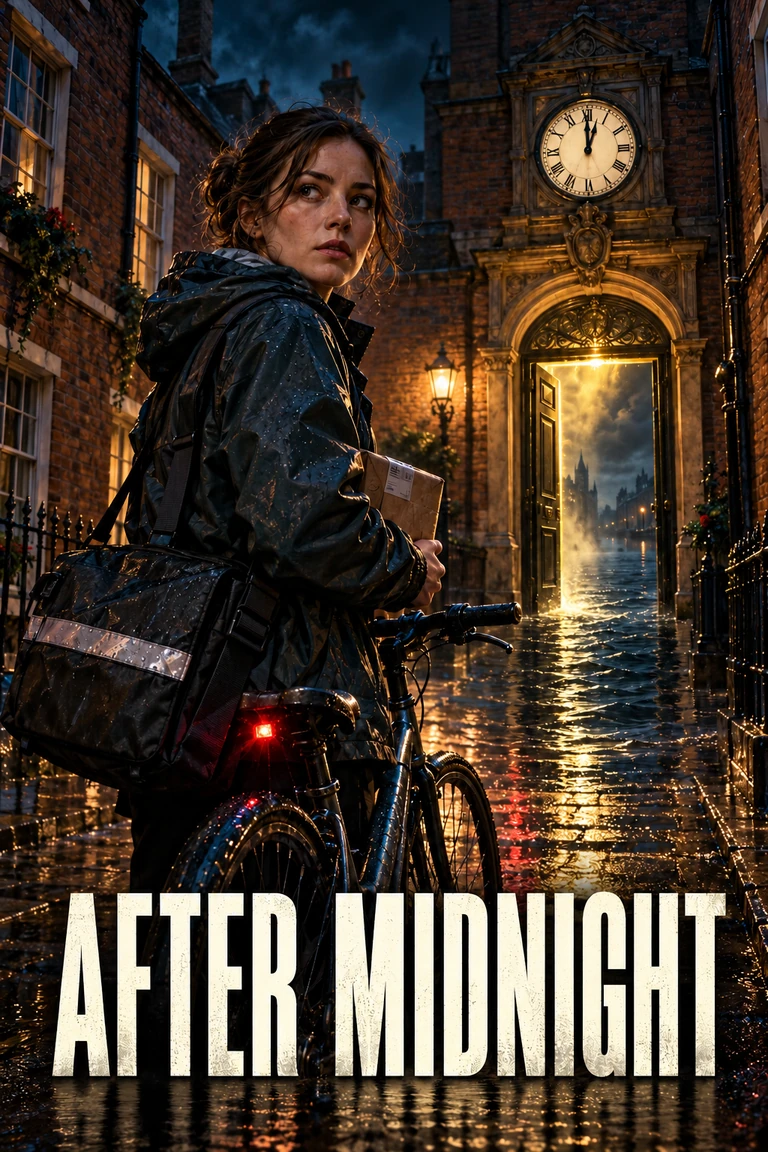
A courier discovers an address that exists for only eleven minutes a day—and a connection to her missing brother. Behind its door lies a neighbourhood the city has chosen to forget. Leah Bell must confront her family's part in the secret before the chance to rescue its residents closes.
ABOUT CHAPTER 1
The Painted Door
Night courier Leah Bell discovers a doorway that exists for eleven minutes each night and finds her missing brother Daniel inside a city disaster held outside ordinary time.
Ep 1 · The Painted Door
Share a short audio preview
Create up to 20 seconds from 0:00. Available for free opening episodes. Preparing a clip downloads this episode on your device.
Read episode 1
The address on Leah Bell's final delivery did not exist.
She knew because she had slept against its wall.
Number Seventeen Lark Lane had been demolished eighteen years earlier. Leah had been nine, her brother Daniel fifteen. The city called the collapse an evacuation. Their mother called it theft. After three years of arguments, their mother stopped calling it anything.
Now Leah's courier screen wanted a signature there.
She called dispatch. Nell answered through a mouthful of toast.
“Last job,” Leah said. “Somebody's making a joke.”
“Somebody paid six hundred pounds.”
“For a letter?”
“For eleven minutes of availability. Midnight to eleven past.”
Leah checked the parcel strapped inside her bicycle basket. Brown paper. String. No sender. The name on the label was hers.
“I'm delivering something to myself.”
Nell stopped chewing.
“Come back, Leah.”
But Leah had already turned into Lark Lane.
The demolition wall stood between a pharmacy and a betting shop. Rain silvered its brickwork. Someone had painted a blue door on it last summer. Leah remembered laughing at the handle, a careful yellow rectangle.
Her watch reached midnight.
The painted handle turned.
A real door opened inward.
Warm air carried the smell of cabbage and furniture polish. Behind the doorway stood a woman in a mustard cardigan. She looked about sixty. She held a saucepan lid like a shield.
“You're late,” the woman said.
“By twelve seconds.”
“Your mother said you would argue.”
Leah lifted the parcel. Her hands had begun shaking.
“My mother died.”
“I know. I'm sorry.”
“Who are you?”
“Agnes Vale. I taught Daniel mathematics.”
Leah remembered that name. A teacher mentioned in missing-person leaflets. Another person the city insisted had moved away.
She left her bicycle outside and entered.
The hallway was exactly wrong. Same brown tiles. Same broken umbrella stand. Same water stain above the stairs, shaped like a running dog. But the emergency sign glowed green, and new copper pipes climbed the old walls.
Agnes shut the door without locking it.
“Do not let me keep you after eleven past.”
“Why?”
“Because tomorrow will arrive very slowly.”
Leah called Nell. No signal. She tried her camera instead. The hallway appeared on the screen. That steadied her. Ghosts, she decided, probably disliked photographs.
Agnes watched her open the parcel.
Inside lay a brass key, a cassette recorder, and an envelope. Leah recognized her mother's handwriting before she touched it.
My darling girl. If Agnes has sent this, I am gone, and Daniel has finally agreed to stop protecting me.
Leah sat down hard on the stairs.
Daniel had not come home from school eighteen years ago. Police said he had run away. Her mother had refused to believe it. Leah had eventually believed the police, because believing Daniel had chosen to leave hurt less than imagining everything else.
She looked up.
“Where is he?”
Agnes did not answer quickly enough.
Leah grabbed the front of her cardigan. The saucepan lid fell, clattering against the tiles.
“Don't use his name unless you know.”
Agnes looked down at Leah's clenched hands.
“He used to put raisins in his pockets,” she said. “He thought we didn't notice when he fed the birds outside my classroom. Once he brought in an injured pigeon. Inside his shirt. It escaped during a spelling test.”
Leah let go.
She remembered washing that shirt. Remembered Daniel begging her not to tell their mother. The memory had the ridiculous precision of things nobody invents.
“I wrote him letters,” Leah whispered.
“Your mother brought them.”
“He never answered.”
“He answered every one.”
Agnes touched a tin on the hallway shelf. It overflowed with envelopes. Leah recognized her own old address, then the address of her first rented room.
“She couldn't bear to give them to you,” Agnes said.
Leah lifted the top envelope. Her name appeared in Daniel's sprawling handwriting. The date belonged to a birthday she had spent angrily alone.
Agnes glanced at the ceiling.
“Upstairs. But you need the recording first.”
“No.”
Leah ran.
On the first landing, a man stepped out of a room. He had Daniel's dark eyes, Daniel's crooked little finger, Daniel's habit of holding his breath before speaking. He also had grey hair at his temples.
“Leah,” he said.
She hit him in the chest with both fists.
He accepted it. Then she folded against him, and he held her so tightly she could not breathe. For a moment neither of them tried to explain anything.
“You stayed,” she finally said. “All this time.”
“I couldn't leave.”
“You're standing next to the stairs.”
“It isn't that kind of couldn't.”
Below them, Agnes called that they had seven minutes.
Daniel led Leah into the old kitchen. A dozen clocks covered one wall. Only one moved. Its hands stood at four minutes past twelve.
The room had become a workshop. Maps covered the table. Bundles of letters filled flour tins. A kettle steamed on an electric ring.
“Do you remember the flood warning?” Daniel asked.
“I remember Mum taking me to Aunt Ruth's.”
“The river wall failed. Seventeen buildings were still occupied. People were waiting for buses that never came.”
“But there wasn't a flood.”
“There was. Then there wasn't.”
He put the cassette into its recorder.
Their mother's voice filled the kitchen.
“My name is Helen Bell. I maintained the municipal clock network. The reservoir under Lark Lane was experimental. It stored differences between synchronized clocks. Tiny differences. Enough to stabilize pumps during power cuts. We discovered it could also store a moment.”
Leah gripped Daniel's wrist.
On the tape, her mother breathed painfully.
“When the wall broke, the council activated it. They held the flood inside eleven minutes. Buildings, water, people. Everything within the boundary. The city outside continued. We thought we could release them the next morning.”
The recorder clicked. Daniel turned the cassette over.
A man's voice replaced their mother's.
“Release would restore the original pressure event,” he said. “We need a permanent containment protocol.”
Leah knew that voice. Everyone in the city did. Councillor Adrian Shaw announced bridge openings, housing grants, winter celebrations. His measured confidence came through every public speaker.
Their mother answered him.
“There are eighty-three people inside.”
Shaw said, “There are two hundred thousand outside.”
Daniel stopped the tape.
“The machinery aged with us,” he said. “The city got rich building on safe river land. Nobody repaired the original breach. They buried it under a transport interchange.”
“Then why can I walk in?”
“There's one maintenance connection. This door. Eleven minutes each night. Objects pass. People registered inside cannot cross without being replaced by an equal living anchor.”
Leah stared at him.
“No,” she said.
“I didn't ask.”
“But you could have. For eighteen years.”
“Eighteen years outside. About seven weeks for us. We only live during the window. Then everything stops. We don't experience the waiting.”
The grey at his temples was dust. Leah brushed it away with her thumb, and Daniel was still nearly the boy she remembered.
Agnes entered. “Three minutes.”
Leah counted breaths. Her whole adult life had passed while Daniel endured less than a year.
“Why didn't Mum tell me?”
“She was trying to repair it. Shaw threatened to cut our power if she spoke. She thought she could finish before she died.”
Daniel pointed to the brass key.
“That's the original engineer's key. She left three records outside. The tape is the first. The second is in the city archive. Agnes arranged the courier order through a terminal. It only connects during our window.”
“Come to the door,” Leah said.
“Leah.”
“I need to see.”
They went downstairs. Leah stepped into the rain. Daniel followed until his hand reached the threshold. His fingers stopped against nothing. He leaned forward. The muscles in his neck tightened. An invisible force held him gently and absolutely in place.
Leah pressed her palm against his.
For an instant, she felt the river. Cold, immense, pressing upward.
Agnes pulled Daniel back.
“Don't offer yourself by accident.”
A white municipal van rolled into the lane.
Daniel's face changed.
“Go. Take the parcel.”
Leah backed toward her bicycle. A man climbed from the van wearing a grey raincoat. He looked from her to the doorway, and Leah recognized Councillor Shaw without his television smile.
“Miss Bell,” he said. “Your mother promised you'd never be involved.”
Behind Leah, the clocks struck eleven past.
The doorway became paint.
Shaw held out his hand.
“Give me the recording, and your brother gets another night.”