
Romance · Published by EpicHear
What We Kept in Silk
The Woman Who Wore It
First 5 episodes free · 4 more: 4 coins, or free with the 24-hour wait (1 episode a day).
1 coin = 1 episode
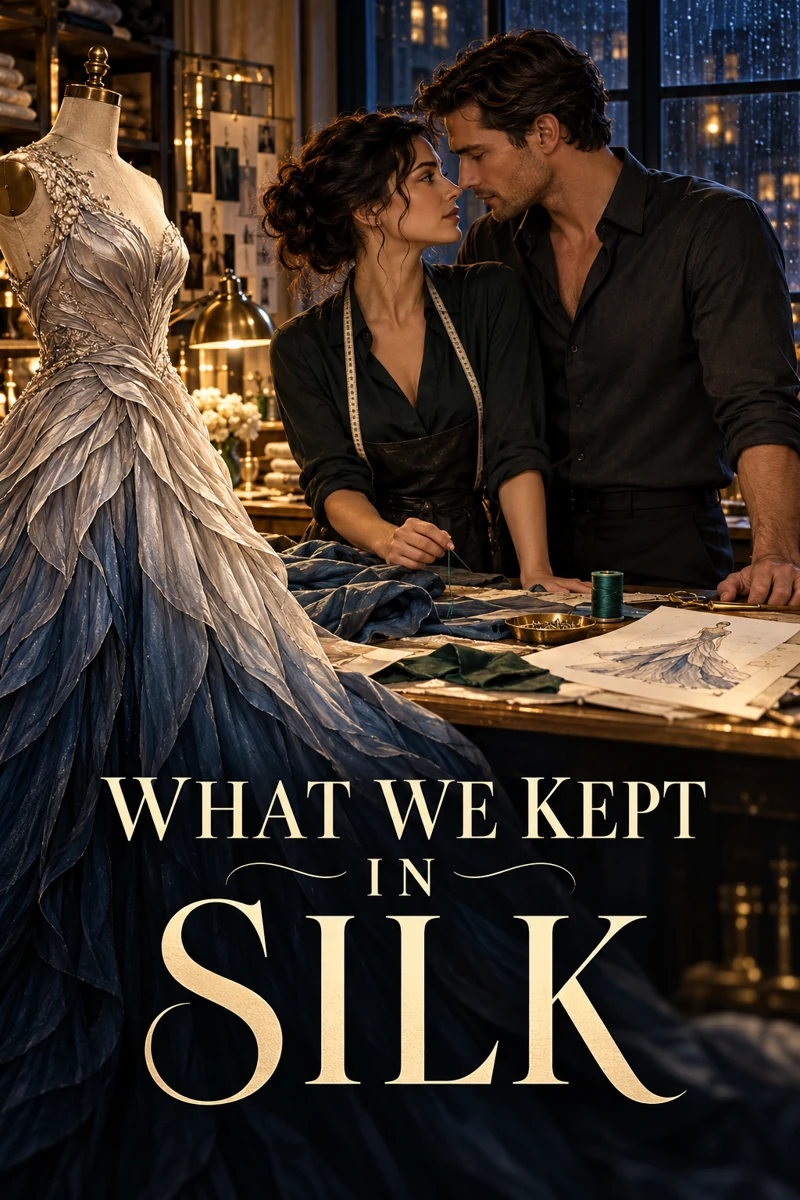
About this book
When textile conservator Ines March repairs a famous silk gown, she discovers evidence that its celebrated designer stole her mother's work. The man who brings it is her former lover—and the designer's son. As old desire returns, Rafael must choose whether love means protecting his family or finally telling the truth.
ABOUT CHAPTER 2
The Woman Who Wore It
Eloise reveals the history behind the silk, while Rafael's engagement draws a boundary around an old attraction.
Ep 2 · The Woman Who Wore It
Share a short audio preview
Create up to 20 seconds from 0:00. Available for free opening episodes. Preparing a clip downloads this episode on your device.
Read episode 2
“The woman was me,” Eloise said.
Ines had expected denial, or surprise, or a request to put the paper back. Instead her mother stood in the doorway of her flat wearing a dressing gown and looking furious that they had arrived without breakfast.
“Come in. Rafael, take your shoes off. You always bring the weather with you.”
He did, immediately.
Ines followed her into the kitchen. Her mother was sixty-two, with a silver plait and fingers that no longer straightened completely. She had stopped doing fine repairs after an injury, but she could still identify a badly set sleeve from across a crowded bus.
Eloise put three cups on the table.
“You hid the drawing in the Nightingale.”
“I hid several things in it. Most were stitches.”
“Mum.”
Her mother sat. The joke left her face.
“We were students. Your father had just left. You were three. Victor had access to a studio and I had an idea. He said we could make a name together.”
She opened a tin that Ines remembered holding biscuits. Inside were photographs, faded receipts and a postcard of a blue lake.
In the first photograph, Eloise stood on a makeshift runway wearing the Nightingale. It was simpler than the dress in the box, with fewer feathers and a straight neckline. But the idea was unmistakable.
Victor stood beside her, already practised at looking toward a camera.
“I made it from remnants,” Eloise said. “The blue wasn’t a grand artistic decision. The shop had run out of silver.”
Rafael studied the photograph.
“Why didn’t you tell anyone?”
“I did. For years, in rooms where nobody was writing anything down.”
Ines waited while her mother folded the edge of a napkin, once, then again.
“After the first show, he offered me a job. Regular wages. Childcare money. I thought credit could come later. There was always a reason later had to wait.”
“Then seven years ago?” Ines asked.
“He wanted a book about his life. The dress would be on the cover. I said I would not repair it for another story that left me out.”
“So he called you a thief.”
“He said I had taken sketches from the archive.”
“They were yours.”
“Yes.”
The word landed without drama. Ines found that worse than tears.
Rafael pushed his cup away. “I was told you tried to sell company material.”
“You were told something convenient,” Eloise said. “People often are.”
Ines looked at him. He met her eyes, then lowered his own.
She remembered their last week together. Her mother dismissed. Rafael promising to find out what had happened. A letter from the company. Money transferred into an account. Then his silence, and hers, and a train out of the city.
“You should have told me about the drawing,” she said to her mother.
“You were already fighting everyone.”
“I might have fought the right thing.”
Eloise reached across the table, but Ines did not move her hand toward her. After a moment, her mother let hers rest on the tablecloth.
“I wanted to keep something that was mine,” Eloise said. “Even the decision to speak.”
Her mother pushed the biscuit tin toward her. Under the photographs was a nursery invoice, neatly folded along the amount due. Ines recognised the nursery's painted gate from a memory she had never connected to money.
“I thought you liked working there,” she said.
“I liked some of it. The women at the next table. Having enough fabric to try something twice. You can love parts of a place that treats you badly.”
Ines touched the invoice without taking it out.
“I used to tell people you made beautiful things for an important designer.”
“You were proud of me.”
“I made you smaller.”
“You were my child. That wasn't your work.”
Rafael rose to fill the kettle. Neither woman thanked him for making the moment easier. He did it anyway, quietly, leaving them the space at the table.
Ines finally moved her hand toward her mother's. The bent fingers closed around hers, familiar and warm. She could be angry about the silence and still want to hold the person who had lived inside it.
The anger did not leave Ines. It became less simple.
Rafael stood. “The exhibition can be corrected.”
Eloise looked up at him.
“Your father is still alive. He will not become generous because you print a different label.”
“Then I’ll need more than a label.”
“What you need,” she said, “is to stop saying what you’ll do before you understand what it costs.”
He sat again.
For the first time that morning, Ines felt something other than the urge to defend her mother or blame him. She remembered liking him before wanting him. He had been capable of listening then. It had made the rest of what happened harder to forgive.
They left with permission to photograph the documents, not to publish them. Eloise kept the originals. She also gave Rafael a slice of toast wrapped in a napkin, apparently unwilling to let historical grievance justify hunger.
Outside, the pavement shone after rain.
“I’m sorry,” he said.
“For which part?”
“For believing that my family had given me the whole story.”
“That belief was comfortable for you.”
“Yes.”
She watched him put the toast in his coat pocket.
“Are you going to eat that?”
“I’m afraid it might be evidence.”
She laughed before she could help it. The sound made him look at her with such naked relief that she turned away.
At the shop, the dress waited under its cover. Ines had finished the wedding hem before going to her mother’s flat. Its owner arrived as they were opening the door, breathless and carrying a bag of pastries as payment for the inconvenience.
The bride tried on the skirt behind the screen. Rafael stood facing the window while Ines checked the hem. When the woman came out, he told her it looked beautiful without making her feel examined.
After she left, Ines handed him a pastry.
“You used to be good at making people feel safe.”
He held it without eating.
“I’d like to be good at deserving it.”
“Then start with something less ambitious than a speech.”
They worked through the condition report. Rafael arranged permission for Ines to examine the archive’s earlier versions of the dress and asked the independent lender to attend. He copied her into every message. Ines noted each step while refusing to let it become proof of a transformed man.
Near noon, he took off his coat to help move a clean table under the window. His shirt pulled across his shoulders. She looked away, irritated by how little consultation desire required.
He noticed. She knew he noticed because he became exceptionally interested in the table leg.
“Your engagement,” she said.
“I’m speaking to Celeste today.”
“About the exhibition?”
“About us. There hasn’t been an us for some time. We’ve both been treating ending it as a problem for after the anniversary.”
“Then end it because it needs ending.”
“That’s what I intend.”
She placed a ruler between them, an absurd little border on the table.
“Until then, you are a man delivering paperwork.”
He glanced down. “A strict jurisdiction.”
“Very.”
The bell rang before either could say more.
Celeste Arden stood in the doorway. She wore a dark green coat, and the ring on her hand was smaller than Ines had expected. Her first glance went to Rafael’s discarded coat. Her second went to the ruler.
Ines refused to move it.
“I called your office,” Celeste told him. “Apparently you were having an urgent meeting with the conservator.”
“We are.”
“I can see how urgent.”
There was hurt in it. Ines heard that before she heard the insult.
“Nothing has happened here that you need to discover by looking at our clothes,” she said. “But there is something you should both discuss somewhere else.”
Celeste looked at her properly then. The anger remained, but it found a different shape.
“Thank you,” she said, very quietly.
Rafael picked up his coat. At the door he turned back toward the covered dress.
Celeste followed his glance.
“So it’s true,” she said. “You’re changing the exhibition.”
“We need to discuss the attribution.”
“My company is underwriting an event built around your father’s reputation.”
“I know.”
She opened the door herself.
“Then you should also know the board has already asked me to withdraw the funding if you touch his name.”