
Romance · Published by EpicHear
What We Kept in Silk
Complete · 9 episodes · ~1 h 15 min
First 5 episodes free · 4 more: 4 coins, or free with the 24-hour wait (1 episode a day).
1 coin = 1 episode
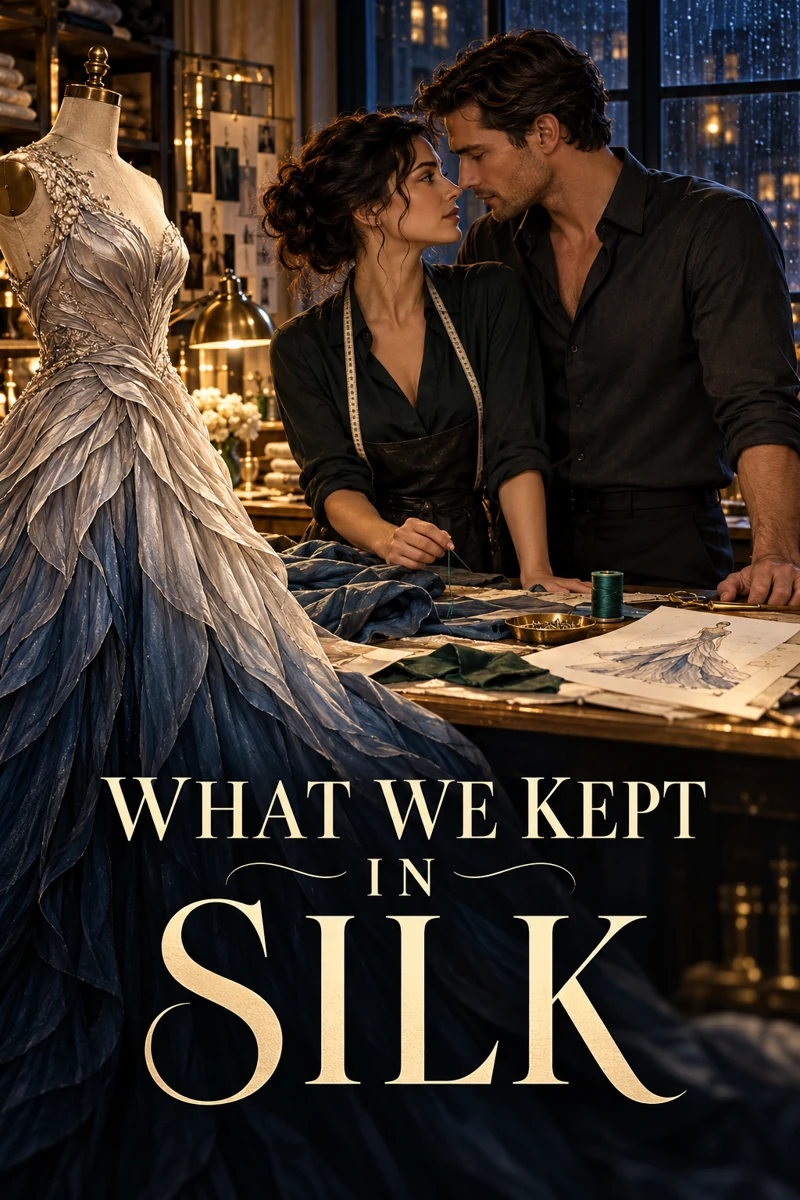
What We Kept in Silk is an AI-narrated romance audio drama in 9 episodes on EpicHear. The first 5 episodes are free in your browser.
About this book
When textile conservator Ines March repairs a famous silk gown, she discovers evidence that its celebrated designer stole her mother's work. The man who brings it is her former lover—and the designer's son. As old desire returns, Rafael must choose whether love means protecting his family or finally telling the truth.
ABOUT CHAPTER 1
The Dress at the Door
A midnight repair brings Ines face to face with her former lover—and a secret hidden in his family's most famous dress.
Ep 1 · The Dress at the Door
Share a short audio preview
Create up to 20 seconds from 0:00. Available for free opening episodes. Preparing a clip downloads this episode on your device.
Read episode 1
The dress arrived at eleven at night, carried by the man Ines March had spent seven years refusing to remember.
Rafael Vale stood in the doorway of her repair shop with a garment box in his arms. Rain darkened the shoulders of his coat. He looked older, which was unfair. She had imagined that if they ever met again, he might at least have the decency to look worse.
“We’re closed,” she said.
“I know.”
“Then the sign is working.”
He looked past her at the wedding skirt spread across the cutting table. She had promised its owner a repaired hem by morning. The rent notice underneath her scissors could wait less patiently.
“I need a conservator,” he said.
“You need a hotel. Several stay open all night.”
“Ines.”
There it was. The way he said her name, without hurrying its second syllable. At twenty-seven she had mistaken that attention for a promise. At thirty-four she knew attention could be real and still fail you.
She stepped aside because rain was reaching the fabric near the door.
Rafael placed the box on the empty table. He did not take off his coat. Once, he had known this room well enough to find the kettle in the dark. That had been before her mother stopped working for his family. Before the dismissal. Before his father told the fashion press that a trusted employee had betrayed the house.
“The Nightingale,” he said, lifting the lid.
Even angry, Ines forgot to breathe for a moment.
The silver dress lay on pale tissue, its silk darkening from pearl at the neck to storm blue near the hem. Hundreds of tiny folded shapes crossed the skirt. From a distance they looked like feathers. Close up, each was a piece of fabric persuaded into flight.
Victor Vale had built his reputation on this dress thirty years earlier. It had appeared on magazine covers, in exhibitions, in the photograph outside the company’s headquarters. Ines had walked past that photograph every day of her apprenticeship.
A jagged tear ran beneath the left arm.
“What happened?”
“An exhibition fitting. Someone pulled instead of waiting.”
“Someone expensive?”
“A board member.”
“Then I’m sure the dress will apologise.”
His mouth moved, almost a smile. She wished he would stop looking like someone who remembered her jokes.
“The anniversary exhibition opens in six days,” he said. “Our textile specialist is ill. The museum recommended you.”
“Did you tell them whose daughter I am?”
“Yes.”
“And you came anyway.”
“I asked them who could do the work. They gave me your name.”
Ines washed her hands before touching the silk. She was angry with herself for doing it. The practical part of her had already accepted the problem: damaged fabric, too much weight, an old repair pulling in the wrong direction.
Rafael watched from the other side of the table. He was thirty-six now. She knew that because she had once baked him a terrible cake for his twenty-ninth birthday. The middle had collapsed. They had eaten it with spoons and called it a pudding.
Before lifting the sleeve, she laid a sheet of clean tissue beneath it. Rafael reached for a second sheet, stopped, and waited until she nodded.
They had once worked that way in the archive after everyone else went home. She would repair a fastener while he read terrible exhibition copy aloud in a grand voice. He had made her laugh so hard she stabbed her own thumb. The memory arrived complete, including the heat of his mouth against the injured finger, and she resented it more than she resented the rain.
“Hold the lamp lower,” she said.
He adjusted it. The light showed a second strain line, faint but spreading toward the shoulder. If she simply closed the tear, the next movement would open another one beside it.
“Someone has tried to make it fit a body it wasn't made for,” she said.
“The fitting should never have happened.”
“No. It shouldn't.”
He heard the second meaning. She saw it in his face and returned her attention to the first, because silk could not be blamed for the company it had kept.
She lifted the damaged sleeve.
“I can stabilise it. I won’t make it new.”
“I’m not asking you to.”
“Your family usually does.”
He accepted that without the quick defence she expected. “Send me your terms.”
She named a fee high enough to cover two months of rent, then regretted the hope that rose in her before he answered.
“Agreed.”
“Half in advance. No photographs of me working. No touching anything without asking. My written report goes to the lender as well as your company.”
“Agreed.”
“And you’re not my client. The company is.”
This time he paused.
“All right.”
His phone lit against the table. A woman’s name appeared above a message. Celeste. Under it, a photograph from a formal dinner: Rafael beside a woman with red hair, her hand on his sleeve.
Ines looked away too late.
“We’re engaged,” he said.
“Congratulations.”
“It’s complicated.”
“No. A complicated repair is where the original material has disintegrated and somebody has glued velvet over it. An engagement is something you need to explain to the person wearing the ring.”
He put the phone away. “You’re right.”
She hated that answer. It left her nowhere useful to put the sharpness.
For several minutes she examined the dress beneath the lamp. Rafael stood quietly, answering when she asked about temperature, storage, previous repairs. He had brought the condition reports. They were clipped together in order. The young man she remembered had carried everything loose and trusted charm to locate it later.
“Who taught you to use a folder?” she asked.
“Several disasters.”
“I hope they were educational.”
“Eventually.”
She found a thread caught inside the damaged lining and stopped.
It was green.
Not a bright green anyone would notice. A small, dark knot, hidden beneath the arm. Three stitches crossed it, then one turned back against the direction of the others.
Her mother had taught her that finish at the kitchen table. Not because it was better than any other finish, but because she liked having a private mark where nobody would think to look.
Every maker ought to know where she has been, her mother used to say.
Ines turned the lining carefully.
“What is it?” Rafael asked.
“Get my camera. On the shelf. Don’t switch it on until I’ve moved the lamp.”
He obeyed. She photographed the knot, then the seam beside it. The repair was newer than the rest. She could tell by the thread, its strength, the way it had been drawn through fabric already worn thin.
She remembered her mother coming home one evening with a bandage on her thumb. That had been seven years ago, the week before the dismissal. Her mother had said she was working on an old friend.
Ines had thought she meant a client.
“This stitching is my mother’s.”
“Eloise repaired most of the archive.”
“Then why does this report say it hasn’t been opened since nineteen ninety-six?”
Rafael came closer, reading the page she pushed toward him. His shoulder nearly touched hers. Her body registered the distance with a precision she resented.
“I don’t know.”
She made him step back before she worked. Under the loose repair was a narrow pocket, no wider than two fingers. She would never have found it without the tear.
Inside lay a strip of thin cotton folded around paper.
“Ines, should we call someone?”
“We are someone.”
She eased it free without pulling at the silk. On the cotton, in her mother’s small handwriting, were four words.
For the person looking.
Rafael said nothing.
The paper held a pencil drawing of the dress, recognisable even before Ines unfolded the whole sheet. The skirt had the same storm-coloured feathers. The shoulder curved in exactly the way Victor Vale always called his signature.
At the bottom was a date, thirty-one years earlier.
And a name.
Eloise March.
Ines stared until the letters stopped making sense. Her mother had been a maker. A skilled pair of hands. That was the story everyone knew. Even Ines had repeated it, proud of the skill and blind to the smallness of the description.
Rafael reached for the edge of the table, then let his hand fall.
“My father said he designed it on a train.”
“My mother never mentioned a train.”
She turned the drawing over.
The message on the back was shorter than the story it threatened to destroy.
If he calls this his again, ask him about the first dress. Ask him what happened to the woman who wore it.