
Romance · Published by EpicHear
The Last Table for Two
A Whole Loaf
First 5 episodes free · 4 more: 4 coins, or free with the 24-hour wait (1 episode a day).
1 coin = 1 episode
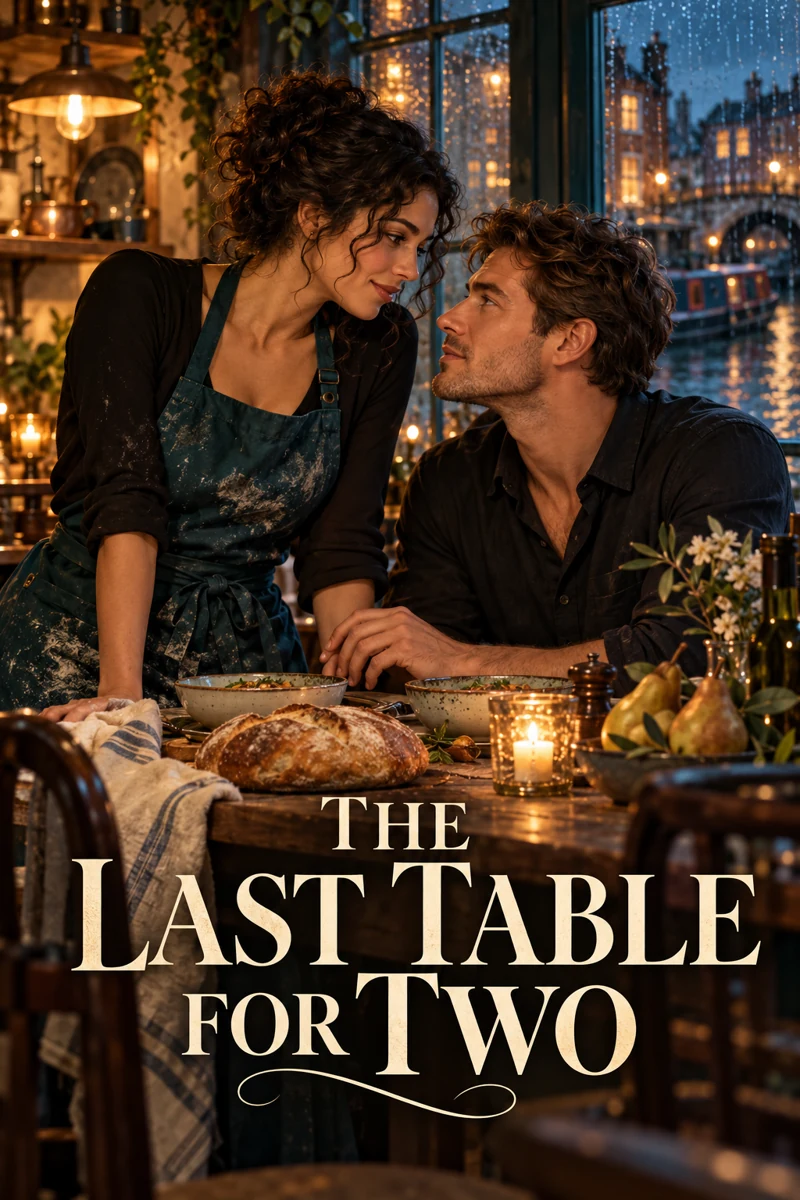
About this book
Chef Iris Bell falls for a charming stranger, then discovers he is the critic whose review devastated her mother's restaurant. Desire pulls them together as family loyalty and a secret Iris buried years ago threaten their new beginning. To keep their love, both must stop hiding behind the stories they tell about themselves.
ABOUT CHAPTER 1
A Whole Loaf
A chaotic supper-club date brings chef Iris an unexpected attraction, until she learns who her guest really is.
Ep 1 · A Whole Loaf
Share a short audio preview
Create up to 20 seconds from 0:00. Available for free opening episodes. Preparing a clip downloads this episode on your device.
Read episode 1
The man at table nine had been given a whole loaf and no knife.
Iris noticed him trying to break it discreetly while her best friend whispered that he was her date. Not a paying customer. Not the refrigeration engineer. The date Iris had forgotten agreeing to, seated in the middle of a supper club she was already failing to run.
“He has excellent hands,” Meena said.
“He'll need them. That crust is reinforced concrete.”
“His name is Theo.”
“The oven's name is unreliable. Introduce yourself to that.”
Meena returned to the kitchen laughing. Iris watched the man turn the loaf over, looking for a weakness. He wore a dark shirt with one sleeve rolled higher than the other. He looked hungry, patient, and entirely too handsome to be sitting beneath the broken extraction fan.
She took him a knife.
“I'm sorry. You're meant to have two slices.”
“I assumed this was an expression of confidence.”
“It was an expression of my assistant misunderstanding a number.”
He offered her the chair opposite. “Would you like half?”
“I'd like another oven and a sensible personality.”
“I'm afraid I've only brought bread.”
She smiled before remembering she was covered in flour. At thirty-four, Iris Bell had stopped expecting first dates to resemble advertisements. Still, she usually managed clean trousers.
The old community hall held nine mismatched tables, two coat rails, and a kitchen designed for tea rather than dinner. Iris rented it three Fridays each month. She called the business Bell's Table. Her mother called it a restaurant without the courage to become one.
Tonight every seat had sold. If she could repeat that through winter, she might have enough saved to take a tiny permanent space. If she burned another tray, she would be feeding those savings directly into the bin.
“I'll come back,” she told Theo. “Assuming nobody dies.”
“From the bread?”
“From asking about the bread.”
In the kitchen, Meena handed her a pan. “You smiled.”
“People smile under pressure. It's a survival response.”
“Then survive for another twenty minutes and sit down.”
Iris plated roasted vegetables, lemon chicken, and the last of the beans. Food she loved eating. Food she could make beautifully without pretending she had twelve assistants and a childhood in a vineyard. It had taken her years to stop apologising for the simplicity.
Her mother arrived during the main course.
Nadia Bell wore her good coat and carried a plastic box. Iris knew the box before she saw inside it. The family honey cake, made in the same square tin since before Iris was born.
“I thought you might run short.”
“I have dessert, Mum.”
“I can see that. Chocolate again.”
“People like chocolate.”
“People like lots of things that aren't memorable.”
Iris took the cake because refusing it would turn the kitchen into a different kind of service. Nadia kissed her cheek and looked through the hatch.
“Who's the man with the loaf?”
“A friend of Meena's.”
“He looks like he writes things down.”
“He looks like he needs butter.”
Nadia frowned at him a moment longer. Then she began rearranging plates. Iris moved them back. Neither mentioned the motion.
During dessert, Iris saw a woman at table six pushing her plate away. She went over prepared for a complaint. Instead the woman said it was delicious, but she had eaten too much bread. Iris offered a box to take it home. The woman looked absurdly pleased by the permission.
Theo watched the exchange without making notes. When Iris passed his table, he said, “You made her feel less embarrassed.”
“About being full?”
“About not managing what she'd paid for.”
Iris shrugged, but the observation stayed with her. Most people complimented a sauce or asked how she had made something. He had noticed the part of the evening that could not be photographed. She wished, later, that liking him had begun with something easier to dismiss.
By ten, most guests had gone. Theo helped an elderly man find his scarf, then stacked his own plate beside the hatch. He did not enter the kitchen or offer to rescue anyone. Iris appreciated that more than she expected.
She took her chocolate dessert to his table and sat down.
“I have eleven minutes before washing up becomes a moral emergency.”
“Then I'll avoid childhood and politics.”
“Good. Both are exhausting.”
He asked what she liked cooking when nobody paid her. She said eggs on toast, eaten standing up. He said that sounded lonely. She said it sounded like not washing another plate.
He laughed, and the laugh changed his face. There was a small crookedness to his front tooth that the rest of his careful appearance had not prepared her for. She wanted him to laugh again. That was inconvenient.
“What do you do?” she asked.
“Write. Mostly for magazines.”
“Things people read while waiting for someone else?”
“Sometimes. I've tried not to take it personally.”
“What about?”
He glanced toward the kitchen, where a pan fell with a spectacular crash.
“Sorry,” Meena called. “No casualties.”
Iris half rose. Theo touched the edge of the table, not her hand.
“You have six minutes left.”
She sat again. “Travel? Politics? Very specific watches?”
“A mixture. Places. People. Restaurants.”
Something in her tightened, then eased. There were thousands of people writing about food. Most wanted a free dinner and called it collaboration.
“You can't have a discount,” she said.
“I wasn't going to ask.”
“You'd be surprised how often I have to say that.”
He put cash beside his plate, enough for the full menu. “Meena said dinner was included in the arrangement. I don't think your work should be.”
Iris looked at the money. It was the first attractive thing anyone had done for her in months that was not intended to be attractive.
They ate in companionable silence until she noticed him looking at the honey cake on the counter.
“My mother's,” she said. “She thinks I might forget how to feed people.”
“Would you mind if I tried some?”
She brought two small pieces. Theo tasted his slowly. Iris found herself watching his mouth, then deliberately watched the window instead.
“My grandmother made something similar,” he said.
“You're not going to ask for the recipe, are you? Mum would need a family tree and three references.”
“I'll settle for this.”
He pushed his plate toward her when she reached for another bite. Their fingers met at the rim. Neither moved immediately.
The hall lights blinked. Meena had found the switch that meant everybody should go home.
Theo helped carry chairs to the wall. Iris let him. Outside, rain had polished the pavement until every streetlight wore a long gold skirt. He stood beneath the awning while she wrestled with the keys.
“Would you have dinner with me somewhere you don't have to wash up?” he asked.
She turned. “You already survived dinner with me.”
“I think I mostly had dinner near you.”
He was right. She was tired enough to dislike being understood and pleased enough to ignore that.
“Sunday,” she said. “Lunch. Nothing elaborate.”
“I can manage nothing elaborate.”
Meena emerged carrying a box of candles. She gave Iris a look of such naked satisfaction that Iris considered dropping the keys down the drain.
Theo took the box to Meena's car, then returned for his coat. His phone vibrated on the table where he had left it. Iris picked it up to move it away from a damp cloth. A message flashed across the screen.
Dana: Need the Vale column by noon. And please tell me the blind date wasn't another chef.
Iris put the phone down.
T. Vale. She knew that name better than she knew the names of her teachers. It had appeared beneath a review her mother kept folded inside an old till drawer. Eight hundred words about a restaurant that had once been their whole life. A sentence about nostalgia being a poor substitute for competence.
She looked at Theo's face as he came back through the door. The small crooked tooth. The patient hands. The man who had asked for a second helping of her mother's cake.
“What's your surname?” she asked.
He stopped.
“Vale.”
“Not just someone who writes about restaurants.”
“I was going to explain.”
“When? After I asked whether you liked the beans?”
His expression changed. Not confusion. Recognition of a mistake he had made himself.
“Iris, tonight wasn't work.”
She picked up the whole loaf he had failed to finish and pressed it into his hands.
“Then take this,” she said. “And don't write one word about my table.”