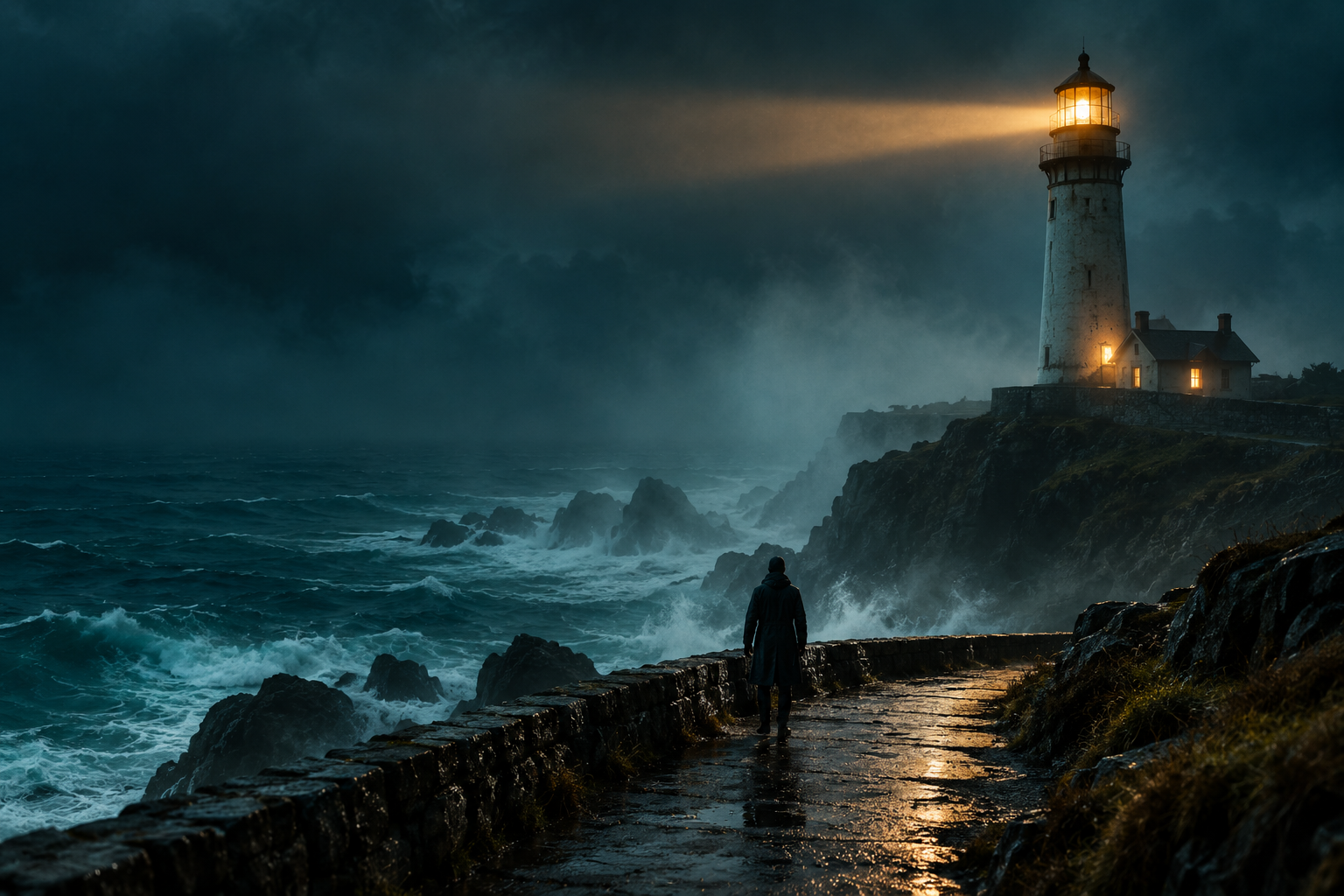
Mystery · EPICHEAR ORIGINAL
The Last Frequency
At 2:17 in the morning, radio archivist Mara Vale hears a woman describe something that has not happened yet. A blue envelope will arrive at the maritime archive. There will be a photograph inside. Before looking at it, Mara must check the window. It is an oddly ordinary message to receive from a lighthouse whose broadcasting equipment was supposedly removed nineteen years ago. More
Mara has returned to the coastal town of Bellweather to catalogue neglected maritime recordings, not to chase prophecies. Her working life is built around checking labels, comparing dates and finding the mundane explanations hidden inside remarkable claims. An old station chime can be copied. A council delivery can be anticipated. Even a convincing photograph can be altered. She intends to test each possibility before giving the mysterious voice a name.
Then the envelope arrives. The image inside shows her own desk, her own recorder and a repair that has not yet been made. Beside the recorder sits a logging card in handwriting she recognizes. Its date belongs to tomorrow. Suddenly, the familiar procedures that have always helped her make sense of the past must be used to investigate the future.
Maintenance engineer Ivo Reed becomes her practical, quietly funny ally. He knows the buildings and equipment that people stop noticing when they work. Mara knows how records acquire authority, and how easily that authority can be misplaced. Together, they begin separating what they have observed from what they merely fear. Their first tools are spare recorders, photographs, phone calls and a careful account of who knew what, and when.
The Last Frequency is an original coastal mystery about messages, memory and the responsibility that comes with apparently useful information. Its suspense grows through conversations and small physical details: an unfamiliar screw, a printer record, a clock setting, a voice almost lost in static. The central question is not simply whether tomorrow can speak. It is whether anyone should trust a warning without understanding who sent it.
Ep 2 · A voice from tomorrow
Read episode 2
Ivo put his bag on the floor without opening it.
"Tell me that's not your handwriting."
Mara held the photograph under the desk lamp. The letters were small and impatient, the final stroke of recording running into the card's printed border. She had written thousands of labels that looked like that. She could not remember writing this one.
"I can't tell you that," she said. "I can tell you I didn't take this photograph."
"Those feel like different levels of reassurance."
"They are."
He drew out the chair beside her. It scraped over the concrete with an unpleasant sound. Both of them glanced at the receiver.
The receiver did nothing.
Mara set the photograph down. "We need to stop giving every noise a personality."
"Fine. The chair is innocent. What do we know?"
She found a fresh sheet of paper, then stopped before writing the date. Yesterday she would not have hesitated. That irritated her more than the photograph.
"We know this arrived today. We know the courier delivered it from Municipal Collections. We know I asked them for lighthouse material on Monday."
Ivo nodded toward the photograph. "We know that looks like your recorder."
"Looks like."
"And your room."
"Looks like."
"You could make a person very tired with those two words."
"Usually takes me longer."
He smiled, briefly. She was grateful for the effort.
They photographed the photograph, its back, the envelope, and the ruler she had used to open it. Ivo asked whether the ruler was a suspect. Mara said it was useful to document the opened edge. He took the picture without another joke.
She put each object on a clean sheet of paper and gave it a number. She did not write evidence. Calling things evidence too early made people choose what they wanted them to prove.
The recorder's yellow tape appeared in both versions of the room. So did a pale coffee ring at the edge of the desk. The photograph showed no person and no reflection that could identify one. The viewpoint was close to the filing cabinet, where an old council inventory camera sat on a bracket beneath the shelf.
Mara had noticed it on her first day. The building manager had described it as part of the equipment register and said the council handled its records. She had meant to ask whether it still worked.
She wrote that down too.
"Could the image have been edited?" Ivo asked.
"Yes."
"Could someone have copied your writing?"
"Yes."
"Could someone have heard me complain about that latch and decided it would be funny to put a new screw in a photograph?"
Mara looked at him. "Have you complained about the latch?"
"It's my job to complain about latches."
For a moment the room felt almost normal.
She called Municipal Collections again, this time asking for the person who had prepared the envelope. Ada Bell came on the line after a short argument with somebody about a printer tray.
"You got it, then," Ada said.
"I did. I'm trying to establish where the photograph came from."
"The transfer queue. It was attached to your request number."
"You printed it?"
"This morning. Is the quality wrong? I asked for the better paper, but apparently the better paper is only for things nobody ever looks at."
Mara wrote printed this morning in large letters.
The photograph had seemed old because of the penciled reference on its back and the faint mark of a removed label. Neither proved that the picture itself was old. She should have separated those questions sooner.
"Was there a sender attached to the file?"
"There'll be a job record. I'll have to ask our records manager for it."
"Could you preserve it, please? The original entry, not just a screenshot."
Ada paused. "Is something wrong?"
Mara glanced at the picture of the repaired latch.
"Something needs explaining. I don't know what yet."
It was the most honest answer she could offer. Ada said she would request the record before leaving, and call in the morning.
After Mara hung up, Ivo took two wrapped sandwiches from his bag.
"I was going to offer the second one an hour ago," he said. "Then your desk arrived from tomorrow."
She accepted it.
They ate beside the objects on their clean sheets of paper. Mara hadn't noticed how hungry she was. She had also failed to notice that Ivo had missed whatever job was supposed to follow the archive visit.
"You don't have to stay," she said.
"I know."
"I mean it."
"So do I. But I do need to make a call."
He went upstairs, giving her a few minutes without questions.
Mara studied the photograph again. If someone wanted her frightened, they had chosen the details well. Her own writing. Her own equipment. A familiar room made unfamiliar by one tiny repair. Nothing large enough to be dismissed as a ridiculous trick; nothing small enough to ignore.
She wished it had been a ghost. She would have known how to disbelieve a ghost.
When Ivo returned, she had drawn three columns. Observed. Possible explanations. Still unknown.
"That looks healthier than staring," he said.
"It's staring with a filing system."
They agreed to leave the receiver on its penciled frequency and make two recordings that night. One recorder would sit beside the radio. The other would capture the room. They would compare clocks before beginning, note which time standard each displayed, and photograph the settings. No claim would depend on a single device.
Mara drew a small box beside each setting. The battery level, the tape length, the distance from the receiver. Ivo checked them one by one while she read them aloud. It felt excessive until she remembered how quickly an ordinary repair had become a question neither of them could answer. This time they would leave fewer gaps.
"And if nothing happens?" Ivo asked.
"We keep the recording of nothing happening."
He considered that. "I like that part."
Before leaving to collect his recorder, he pointed at the window.
"We have pictures of the old latch now. Do you actually want it to stay broken?"
Mara looked from the window to the photograph.
For one uncomfortable moment, she wanted to refuse just to spite it.
That was still letting the picture choose.
"Fix it," she said. "Write down when."
He did both.
Later, she prepared a logging card for the session that would begin after midnight. She wrote the coming date, checked the recorder battery, and added a reminder to avoid repeating her earlier mistake.
This time, keep recording.
The words brought her hand to a halt.
She compared the card with the photograph. She could not tell whether she had independently chosen the phrase or copied it because it was already in her head.
She added the uncertainty to her notes.
At two twelve, they started both recorders.
Ivo sat beside the radiator, coat folded over his knees. Mara kept her hands flat on the desk. The logging card lay beside the recorder, exactly where she had placed it. She avoided looking at the camera bracket.
Four minutes passed.
Then another.
Three notes rose from the receiver.
"The replacement ferry bell will carry the number six one four," the woman said. "Check when the number was assigned. Check who knew it."
Mara turned toward Ivo. He held up one finger, asking her to keep quiet.
The voice faded into a grainy wash of sound.
For several seconds Mara thought the message had ended. Then, underneath the static, the woman spoke again, so softly that Mara had to lean toward the receiver to hear.
"Ask the keeper what happened to the missing minute."