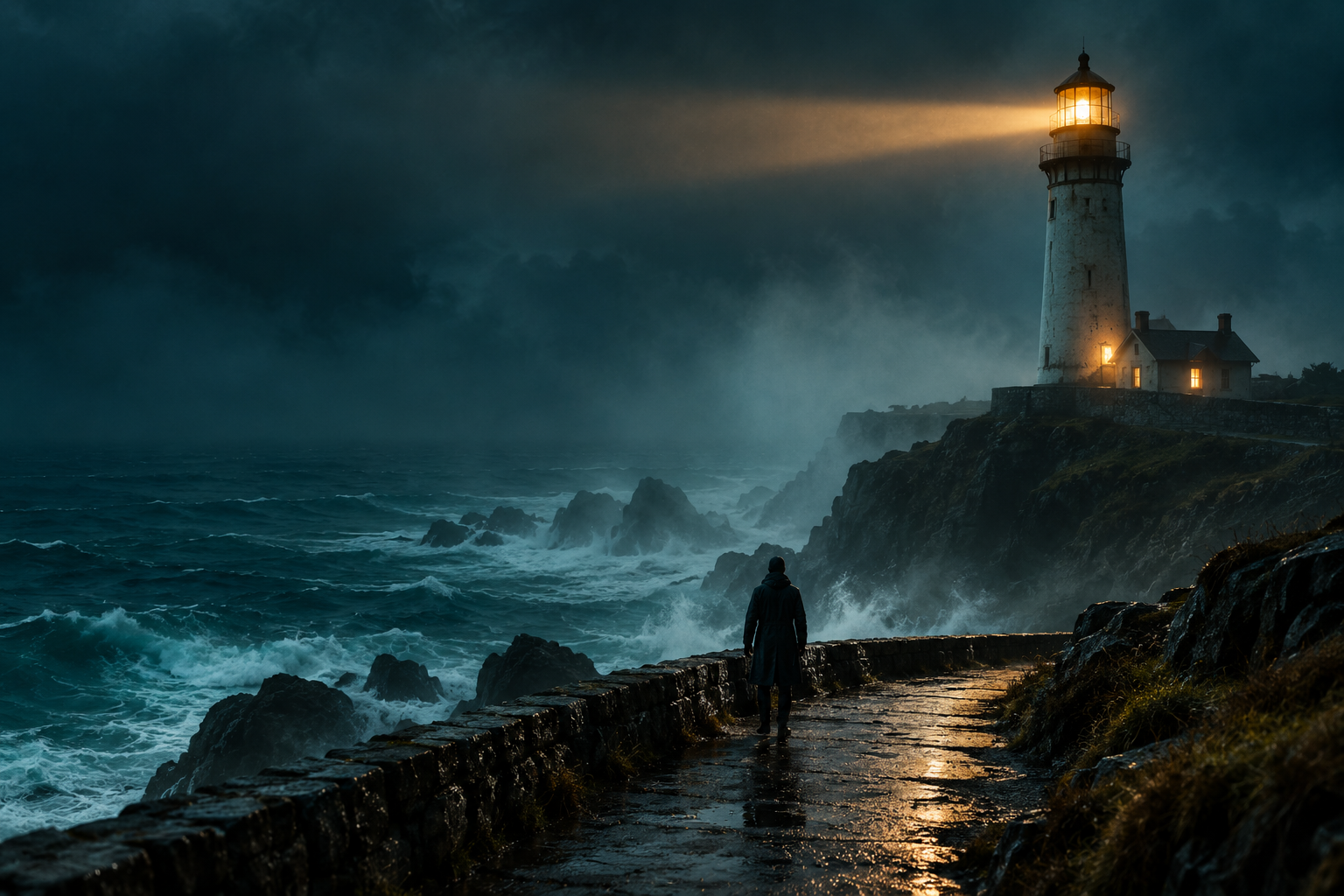
Mystery · EPICHEAR ORIGINAL
The Last Frequency
At 2:17 in the morning, radio archivist Mara Vale hears a woman describe something that has not happened yet. A blue envelope will arrive at the maritime archive. There will be a photograph inside. Before looking at it, Mara must check the window. It is an oddly ordinary message to receive from a lighthouse whose broadcasting equipment was supposedly removed nineteen years ago. More
Mara has returned to the coastal town of Bellweather to catalogue neglected maritime recordings, not to chase prophecies. Her working life is built around checking labels, comparing dates and finding the mundane explanations hidden inside remarkable claims. An old station chime can be copied. A council delivery can be anticipated. Even a convincing photograph can be altered. She intends to test each possibility before giving the mysterious voice a name.
Then the envelope arrives. The image inside shows her own desk, her own recorder and a repair that has not yet been made. Beside the recorder sits a logging card in handwriting she recognizes. Its date belongs to tomorrow. Suddenly, the familiar procedures that have always helped her make sense of the past must be used to investigate the future.
Maintenance engineer Ivo Reed becomes her practical, quietly funny ally. He knows the buildings and equipment that people stop noticing when they work. Mara knows how records acquire authority, and how easily that authority can be misplaced. Together, they begin separating what they have observed from what they merely fear. Their first tools are spare recorders, photographs, phone calls and a careful account of who knew what, and when.
The Last Frequency is an original coastal mystery about messages, memory and the responsibility that comes with apparently useful information. Its suspense grows through conversations and small physical details: an unfamiliar screw, a printer record, a clock setting, a voice almost lost in static. The central question is not simply whether tomorrow can speak. It is whether anyone should trust a warning without understanding who sent it.
Ep 1 · The signal at 2:17
Read episode 1
The voice on the radio told Mara what would arrive in the morning.
Not the weather. Not the tide.
A blue envelope.
She had been alone in the Bellweather archive for six hours, sorting recordings nobody had listened to in thirty years. Outside, rain ticked against the basement windows. Inside, the radiator made a small, persistent knocking sound.
Then three notes rose from the receiver on the shelf.
Mara stopped typing.
The notes were familiar. As a child, she had heard them before the harbor forecast, usually while her mother searched for a second shoe. But the local station had closed before Mara left for university.
She looked at the receiver. Its dial glowed green.
She had assumed it was disconnected. Following its cable with her eyes, she found a plug behind a filing cabinet.
Fine. Electricity. A useful place to begin.
The clock above the door showed two seventeen.
Through a wash of static, a woman spoke.
"In the morning, a blue envelope will be delivered to the maritime archive. Please leave the photograph inside until you have checked the window."
Mara glanced toward the glass. Rain. A strip of pavement. Nothing else.
She reached for her phone, missed it, and knocked a pencil onto the floor. Her field recorder was already on the desk, connected to her headphones. She pressed its red button.
"Say that again," she said.
The woman continued, indifferent.
"The window is important."
The three notes sounded once more. Then the transmission disappeared.
Mara kept recording.
For another minute, the headphones carried only static and the faint electrical hum of the room.
She stopped the recorder and wrote down the frequency before touching the dial.
Underneath it she wrote: Woman. Blue envelope. Photograph. Window.
Then she added a question mark to every line.
At thirty-two, Mara made her living finding reasons not to believe labels. She had once spent four days proving that a supposedly historic foghorn recording was a refrigerator in a museum office. People copied dates incorrectly. They reused tapes. They remembered voices that had never been there.
A radio receiving a strange broadcast was not a mystery yet.
It was a radio doing its job.
She turned the dial. A shipping report emerged, then music, then a language she couldn't place. Returning to her penciled frequency brought back the empty hiss.
Someone with a transmitter could have said anything.
Someone who knew the archive could have said something designed to bother her.
She saved the recording twice.
Only then did she notice she was still watching the window.
By nine, daylight had turned the basement ordinary again.
Mara bought coffee from the bakery and called Ivo Reed, the maintenance engineer whose number appeared on every appliance in the building.
"Does the archive have some kind of radio test?" she asked.
"Does it have a working kettle?"
"I'm serious."
"So am I. That kettle's older than me."
She told him about the transmission. She left out the envelope at first. Saying it aloud would make it sound more foolish than it had in the dark.
"Could be an enthusiast," Ivo said. "Could be a recording getting relayed. What frequency?"
She read it out.
"Write it down," he said.
"I did."
"Of course you did. I'll come by after the ferry workshop. Don't take the receiver apart."
"That was not my next step."
It had been her next step.
Instead she searched the archive's station index. The three-note chime appeared on a cassette labeled coastal service, nineteen ninety-one. She listened to a man report moderate visibility, followed by a buoy warning and the same rising notes.
The catalog listed the transmitter location as North Point Lighthouse.
Mara opened the accompanying maintenance file.
The broadcasting equipment had been removed nineteen years earlier. A final inspection listed the rooms as empty. There was a photograph of an engineer standing beside a square of cleaner paint where a cabinet had been.
She copied the reference number.
An old chime could be copied as easily as an old song. She reminded herself of that while she opened the next file, and again while she checked the date.
At eleven twenty, someone knocked upstairs.
The archive shared its entrance with a closed tourist office. By the time Mara reached the front desk, the courier was trying to balance three parcels against his hip.
"Vale?"
"Yes."
He slid a blue envelope across the counter.
She didn't pick it up.
"You all right?" he asked.
"Who sent this?"
"It's on the label."
Bellweather Municipal Collections. A local address. Her name, printed correctly. Beside it, a tracking number and a rectangle of clear tape.
Nothing impossible.
She signed for it anyway, badly enough that the courier turned the little screen around to check.
Back downstairs, she set the envelope beside her coffee and called the collections office.
The woman who answered sounded tired, busy, and nothing like the voice on the receiver.
"You requested the lighthouse material," she said.
Mara opened her sent email. On Monday, she had asked for anything missing from the communications collection. Photographs, ledgers, correspondence.
There was the reply. One outstanding item located. Delivery arranged.
She had read it. She remembered reading it.
"Did you tell anyone what color envelope you'd use?"
A pause.
"They're all blue."
Of course they were.
Mara thanked her and put down the phone.
She felt relief first, then embarrassment. The archive employed volunteers. The council knew she'd returned. Her request could have passed through half a dozen hands. All somebody needed was a transmitter and a poor sense of humor.
She almost opened the envelope.
Please leave the photograph inside until you have checked the window.
Mara looked up.
The left basement window had a pale triangular patch in one corner, a piece of replacement glass fitted long before she arrived. A brass latch hung slightly crooked. Beyond it, people passed in pieces: shopping bags, knees, the wheels of a pushchair.
She photographed the window with her phone. Then the envelope, front and back.
When Ivo arrived, she was holding it against the desk lamp.
"That won't help," he said. "Council paper. You could build a boat out of it."
She explained the rest.
He listened without smiling. She appreciated that more than she wanted to.
"So somebody knew a delivery was coming," he said.
"Yes."
"Let's find out what they knew."
She slit the edge with a ruler.
A single photograph slid out, facedown. On its back was a penciled accession number and a faint rectangle where an old label had peeled away.
Mara turned it over.
It showed her room.
Not a room like it. The basement archive, viewed from beside the filing cabinet. The crooked latch was visible. So was the pale triangle in the window.
In the photograph, the clock above the door showed two seventeen.
"When was this taken?" Ivo asked.
Mara couldn't answer.
The desk was hers. On it sat her field recorder, the model she had bought last spring. A strip of yellow tape covered its cracked battery door.
She touched the same tape on the recorder beside her.
"Someone's been in here," she said.
It was a good explanation. A solid, unpleasant explanation.
Then she noticed the window again.
In the photograph, the crooked brass latch was straight. A bright new screw held it in place.
Ivo followed her gaze to the actual window.
"I brought a replacement screw," he said quietly. "It's in my bag."
Neither of them moved toward it.
Mara bent over the photograph. Beside the recorder lay a white logging card, one of the blanks she kept in the top drawer. Someone had written on it in her narrow, slanting hand.
She carried the photograph to the lamp.
The date was tomorrow's.
Under it, in writing that looked exactly like hers, were four words.
This time, keep recording.